The June 4th, 2006 maiden voyage of Freedom of the Seas sold out in five hours this morning. I'm booked for much later in 2006…
Operators on the phone did not have deck plans but were able to find rooms close to one another through the computer reservation system.
On the cruise I selected, I got the last balcony stateroom available on the ship and an interior stateroom across the hall.
Josh Poulson
Posted in category “Cruising” Monday, Feb 28 2005 03:38 PM | Permalink | No comments | No trackbacks
On Fox News we see a alert indicating multiple US officials have leaked the information that intercepts indicate Usama Bin Laden has ordered Abu Musab al-Zarqawi to “focus on attacks inside the United States.”
While much bravado is indicated in the article saying that Zarqawi is spending more time staying out of custody than he is attacking, he has certainly made a name, and a nuisance, of himself in Iraq. He has killed a lot of people, publicly, and in the most horrible manner he can contrive.
Of course, it could have been a calculated leak in order in deflate the US euphoria after the successful elections in Afghanistan and Iraq and also the anti-Syrian sentiment in Lebanon that has resulted in the resignation of the Syrian-backed Prime Minister and his government there. If Democracy is on the march then Bin Laden and Zarqawi will want to make sure it appears to be marching out of step, in the wrong direction, or in retreat.
Josh Poulson
Posted in category “Terrorism” Monday, Feb 28 2005 01:29 PM | Permalink | No comments | No trackbacks
I took on eight credits this term, which was aggressive but certainly doable, based on the work I did last quarter.
Finance (MST 572) went fine. There was a lot of reading but nothing was impossible. I ended up with a decently solid A. I just finished the class this past weekend.
Marketing (MST 573), however, has been a disaster. I will be taking an incomplete and I'm barely hanging onto that. It has been a quarter fraught with changing assignments, lots of reading with quick turnarounds (I don't mind reading, but 48-hour deadlines stink), frequently in-person during-the-day meetings and interviews, and a poorly laid out syllabus and forum structure. I tried to drop this class and the instructor talked me out of it. I probably shouldn't have let that happen. If marketing is all about being a disorganized mess, I'm glad I'm not really part of it.
Next quarter also has eight credits, but no one is warning me about those classes. Everyone warned me about 573…
Josh Poulson
Posted in category “School” Monday, Feb 28 2005 08:19 AM | Permalink | No comments | No trackbacks
Yesterday was a relatively quiet day on pun.org. We went the Oregon Museum of Science & Industry (OMSI) with Alana's second grade class. There were a lot of chaperones so it was a popular destination. Because the Poulson family are members, we got to wander around and be experts on the place for many of the others.
Key things to see were the Animal Grossology Exhibit, which was pretty fancy but the kids ran around trying to do the activities rather than find out what the displays were talking about, the OMNIMAX movie, Forces of Natures which was exciting for everyone watching, and another film called Secrets of the Cardboard Rocket at the planetarium. I was hoping to see Pacific Northwest Skies at the planetarium as well, but everyone was pretty tired at that point.
I think Alana had a lot of fun…
Josh Poulson
Posted in category “General” Saturday, Feb 26 2005 08:32 AM | Permalink | No comments | No trackbacks
Today's Financial Times has an article about the predatory behavior of Trading Technologies, a firm that has been awarded two software patents in the UK, presumably based on its US patents 6,772,132, 6,766,304 and 6,828,968. I couldn't find the European patents in question. These patents are broad enough that many entry-order systems could be covered by the claims. The article indicates that Trading Technologies also has eighty more patents in the pipeline.
While Pamela Jones at Groklaw laments the prodigious number of software patents in Trading Technologies pipeline, it is also important to look at the effect on the financial markets.
One of the patents appears to describe any trading order entry system that displays market depth (essentially the difference between highest bid and lowest ask prices) and allows a trader to select (with one click) a region of prices in which to place an order it could affect a large number of home-grown or commercial trading software. The next patent describes the fancy table that is used to describe the market. The third appears to patent the idea of using multiple colors to make a more readable chart, although the added value comes from specifying additional colors to parameters of the table on the fly.
So why do patents on visual analysis and order entry tools matter to us? Because Trading Technologies is actively suing and getting settlements from other trading software companies:
TT… has won damages for patent infringement from the Chicago-based brokerages Kingstree Trading and Goldenberg Hehmeyer, both of which settled remarkably quickly.
The independent software vendor has launched another case of patent infringement against eSpeed, the electronic arm of the US brokerage Cantor Fitzgerald. Earlier this month the judge, in an interim decision, made comments favourable to TT’s case, saying that eSpeed had not raised substantial questions against it.
So, that would make trading software with useful analysis tools and order entry systems a bit more expensive. Is there more than that?
TT has proposed to the four main futures exchanges—two in Chicago, plus Euronext.Liffe and Eurex—that it should be paid a fee for not starting patent infringement cases against them. It has taken out full-page advertisements in the Financial Times and The Wall Street Journal setting out its argument in an open letter. TT wants 2½ cents for each side of a trade, which would amount to revenue of about $130m annually.
That's the key bottom line. It's trying to leverage a patent that holds for a couple decades into a permanent licensing agreement. “Pay us five cents a future trade forever, get sued, or not be able to show market depth with one-click trade orders for 17 years!”
In addition, there's a time limit on the decision.
TT’s open letter said that if the exchanges rejected its request for 2½ cents per trade, it would instead raise the price of its software and step up its litigation programme. But it also said it might accept a takeover offer if the right offer emerged.
Well, you never get rich without being brazen, but these guys are playing hardball. You can read their open letter to the future markets here.
So will futures trading be hampered by software patents, cost more because of software patents, or will the European Union reject software patents and move the future of the futures markets to foreign soil because US Patent Law is so forgiving of software patents? The clock is ticking…
Josh Poulson
Posted in category “Business” Thursday, Feb 24 2005 09:33 AM | Permalink | No comments | No trackbacks
This morning I got a email from Royal Caribbean about Freedom of the Seas reminding Crown & Anchor Society members that come February 28th they'll be able to book rooms on this ship before the rest of the general public. We didn't get any new pictures, but we got a few teasers.
Extensive WiFi capabilities and connectivity for cell phones. Because when you're on vacation it's great fun to let the folks at home know what they're missing.
Staterooms and balconies that are among the largest in the industry. Plenty of room to relax and plan your adventures.
A full-size, flat-screen TV in every stateroom. But then again, with all the incredible vacation activities to explore, try not to be too disappointed if you have trouble finding time to turn it on.
That stuff we already knew. What we didn't know was the cruise route:
Freedom of the Seas will be sailing year-round, 7-night Western Caribbean itineraries from Miami. Ports of call will include Cozumel, Mexico; George Town, Grand Cayman; Montego Bay, Jamaica; and Labadee®, Hispaniola. So basically, we'll be ready to set sail to tropical paradise whenever you need a vacation.
This is almost the same cruise as when I got married, except in the opposite direction!
They remind us that more pictures and details are forthcoming, but that's all we get for now. Deck plans will be coming in March.
Josh Poulson
Posted in category “Cruising” Thursday, Feb 24 2005 08:06 AM | Permalink | 3 comments | 1 trackback
So, by patchng together screenshots and spoiler pics, an enterprising individual has pasted together the entire Star Wars Episode 3 storyline, in pictures.
Josh Poulson
Posted in category “General” Wednesday, Feb 23 2005 05:34 PM | Permalink | No comments | No trackbacks
Randy Barnett muses that having a Libertarian Party might be a problem for libertarianism.
I think that the creation of the Libertarian Party has been very detrimental to the political influence of libertarians. Some voters (not many lately) and, more importantly, those libertarians who are interested in engaging in political activism (which does not include me) have been drained from both political parties, rendering both parties less libertarian at the margin.
I think I agree with him. The LP has been an escape valve for dissatisfied activists. However, since those who head for the LP are not necessarily coalition builders, the LP suffers from far worse factional infighting than the parties those individuals escaped!
Libertarians value principles quite highly, and many deride compromise. That makes it hard to build a power base.
While some libertarian political activists are certainly Republicans and Democrats, the existence of the Libertarian Party ensures that there are fewer activists and fewer voters in each major party coalition than would otherwise exist. Therefore, each party's coalition becomes less libertarian.
Has this marginalized position also led to the difficulty of selling limited government to the people? I'd like to think that it's large population clusters like the big cities that make people comfortable with a powerful government, and not the learned behavior of the voters after thirty years of being told not to “waste your vote.”
Perhaps it is time to dissolve the Libertarian Party and take the fight back into the organizations that spurned us.
I said something similar earlier today replying to Gideon Strauss at Pejmanesque.
Josh Poulson
Posted in category “Politics” Wednesday, Feb 23 2005 01:03 PM | Permalink | No comments | No trackbacks
So, it turns out the school Ahmed Omar Abu Ali attended and at which he earned the title “valedictorian” was the Islamic Saudi Academy. This school is funded by Saudi Arabia and follows Wahhabism, the fundamentalist Islamic movement. It is a major sect in Saudi Arabia, and is the faith of many Islamic terrorists, like Osama Bin Laden.
Added to my comment yesterday that his father was a important offical at the Saudi embassy and it's clear that Abu Ali is not exactly your typical High School graduate. Kinda diminishes the impact of his positioning (by the Associated Press) as a Texas-born, valedictorian at a Virginia high school who just happened to go to college in Medina image, doesn't it?
Josh Poulson
Posted in category “Terrorism” Wednesday, Feb 23 2005 12:36 PM | Permalink | No comments | No trackbacks
On this day in 1836 Santa Ana took the Alamo in a town that has now become San Antonio, Texas.
Coincidentally, on this day in 1945 raised the flag over Mount Suribachi on Iwo Jima resulting in the now-famous picture and subsequent memorial.
Josh Poulson
Posted in category “General” Wednesday, Feb 23 2005 06:07 AM | Permalink | No comments | No trackbacks
Because of Instapundit and a few other posts I've seen today, I see that there's a new factional fight brewing in the GOP.
When the Libertarian Party agreed to partially fund the Conservative Political Action Conference (CPAC) to reach out to other organizations it was a bit of a gamble. Would they manage to appeal to fiscal conservatives without annoying the social conservatives? After all, I went with the GOP pretty strongly in the 2004 election primarily because of my split with many in the Libertarian Party that disagreed with the War on Terror.
Well, apparently there was some friction at CPAC. Ryan Sager noted it in his article on the event entitled “The Right's Right:”
No, the arrogance that will prove problematic, ultimately, was that directed at the libertarian-leaning conservatives by the social conservatives. The message in that regard was clear: We Christians can do this alone, y'all who ain't down with J.C. best be running along.
Such an attitude is unfortunate. After all, there were a lot of organizations there:
More than 90 organizations sponsored the event, including the Objectivist Center, Americans for Tax Reform, the NRA, the National Taxpayers Union, the ACLU, Heritage Foundation, Bureaucrash, the Drug Policy Alliance and a host of others.
The LP tried to leverage the event and obviously failed:
“While we aren't aligned with the political views of these other groups on all subjects, the other groups didn't necessarily line up on every issue, either,” said LP Executive Director Joe Seehusen. “By taking part in this CPAC conference, we hope to show that Libertarians are the true fiscal conservatives—much more so than the Republicans are.”
Various speakers were booed for their divergent views. It prompted Ryan Sager to write,
In fact, if there was anything particularly striking about this year's CPAC, it is to just what extent Republicans have given up being the party of small government and individual liberty.
Make absolutely no mistake about it: This party, among its most hard-core supporters, is not about freedom anymore. It is about foisting its members' version of morality and economic intervention on the country. It is, in other words, the mirror image of its hated enemy.
That's a pity. The people I meet from the GOP at a local level are very nice people that respect my differences of opinion. They even respect that I don't consider abortion and gays to be important topics of discussion and that I don't think government should be in the business of minding other people's business.
Bill at INDC Journal also noted Ryan Sager's column and added a warning of his own:
I would advise all of my respected socially conservative friends and fellow bloggers to take note: a lurch towards sane national defense and fiscal policy by a charismatic Dem or three (it could happen), coupled with one too many sneering “RINO” jokes from you hard righties, and this moderate—and many like me—are gone. One day we'll simply snap, our better judgment overwhelmed by a wacky sense of humor and stewing anger, and you'll wake up to a nightmarish world where the senior senator from Mass rides into the sunset as SecState and Billary is floating doomed socialized medicine schemes out of the Oval again.
What can I say besides, “hear, hear!” …although I would probably add gun rights to the list. I didn't so much vote for Dubya as much as against Kerry and his ilk. It was the same in 2000 when I votes for Dubya because Al Gore was a gun-grabbing taxaholic goof.
Ramesh Ponnuru responded to Sager on National Review Online's The Corner
If conservatives brush off libertarians more often--and I'm not sure that they do--that may reflect the simple fact that conservatives have a stronger position within the Republican coalition. If Sager's got any evidence or even an argument that the party's political success requires increased libertarianism, I'm sure a lot of people would be interested in hearing it.
Sager quickly wrote back:
I’d say that while a big chunk of the Republican base wants to believe that that 2004 election was won on “moral values,” the fact is that it was won on the War on Terror.
While much has been made of the fact that 22 percent of voters chose “moral values” as their most important issue when asked in exit polls—making it the most popular of the options given—that was only because “terrorism” and “Iraq” were listed as separate choices. Together, those foreign-policy topics were the deciding factor for 34 percent of voters.
Right on.
I was strongly in favor on the response to 9/11 and skeptical about Iraq. Ultimately it appears it was all proved correct.
I also believe that, long term, the Republican Party can only grow its base by shedding the stigma of being the party of intolerance. President Bush seemed to understand this when he took office, and he’s made inroads in the black and Hispanic communities by asking for the votes of blacks and by dropping the un-American crusade against illegal immigrants. But he’s made a short-sighted political calculation—perhaps based on electoral math in states like Ohio—to use gay marriage as a wedge issue.
Gay marriage is a good example. My opinion is that government has no business regulating marriage. The fact that they want to have a massive spat about it clearly indicates that other people have different values. I can accept that but I'm not changing my position for them.
Ramesh Ponnuru gets the last word, though.
Most sets of positions on contested political issues bring advantages and liabilities to the party that holds them. It is certainly true that social conservative positions—and the attitudes these positions are perceived to signify—alienate some voters… But they also bring in voters. The same can be said of opposition to big government: It too appeals to some voters and alienates others (at least when it's put in terms of opposition to specific government interventions).
If you want some of conservatism's libertarian elements to be strengthened—and I join Sager in wanting this—getting a clear view of our actual political circumstances is a prerequisite. Sager's a smart guy, but I think that his political prescriptions reflect wishful thinking on his part.
That's all well and good, but those that lean libertarian like me don't like it at all. What are the principles that drive the party? What are the values? It's when pandering to the base comes about that makes libertarians sneer “Demopublican or Republicrat, what's the difference?”
I dropped Bush senior like a rock for two reasons. First was his assault weapons ban. Second was his comment about atheists. That's when I knew the GOP did not have my values at heart.
Jon Henke at Q&O also comments on this growing dispute:
The “Fusionist” alliance that long-existed between Traditionalists and Libertarians is being strained by the near-total abdication of “limited government”—the principle around which we could rally—by the current leadership of the GOP.
There's a schism coming, and the fight will be between the libertarians (us, for example, as well as many of our readers), the fiscal conservatives (Gingrich, Kemp, et al) the moderate/centrists (Christine Todd Whitman, Giuliani, Schwarzenegger) and the social conservatives. (Falwell, Dobson, Santorum)
This struggle is the warning shots for the fight over who runs for President in 2008, though.
I have to say I don't like the anti-gun Whitman, Giuliani and Schwarzenegger (or, for that matter, the anti-gun mouthings of Bush) and I don't like the “true believer” attitudes of Falwell, Dobson and Santorum. I pretty much distrust true believers of any stripe, be it religion, economics, environmentalism or even gun owners.
For obvious reasons (limited government), we Neolibertarians can form an alliance with fiscal conservatives. We can even work with the Centrists, who share many of our socially tolerant views. The Social Conservatives, on the other hand, seem far less interested in limited government. In fact, they seem just fine with an expansive government, so long as that government is working towards their own social/cultural ends.
If Ramesh is right and limited government positions lose the GOP votes (the LP sure ain't stealing too many elections from them) then there has to be some sort of (unholy) alliance to save the soul of the GOP from the true believers that put their faith before the best interests of the country.
Jon says the same thing:
When they lose power—and they will—the GOP must have a faction, and a person, who will create a new coalition during the interregnum. As Dale has written before, such “socially tolerant, fiscally conservative” moderates as Schwarzenegger, and Rudy Giuliani may prove unbeatable on the national stage. If we want to remain a voice within the GOP, I suspect we'll need to hitch our wagon to their coalition, while we still have some political capital. Such a coalition will require uncomfortable compromises, but I really don't see any other possible alliances.
I'm all for it, so long as I don't have to lose my guns. That's the only place where I distrust the center-right.
Josh Poulson
Posted in category “Politics” Tuesday, Feb 22 2005 03:09 PM | Permalink | No comments | 1 trackback
Today's big news maker is Ahmed Omar Abu Ali, the valedictorian of a Virginia high school who allegedly went on to join an Al Qaeda cell in Saudi Arabia and plot the assassination of the President.
According to Fox News and the AP,
The federal indictment said that in 2002 and 2003 Abu Ali and an unidentified co-conspirator discussed plans for Abu Ali to assassinate Bush. They discussed two scenarios, the indictment said, one in which Abu Ali “would get close enough to the president to shoot him on the street” and, alternatively, “an operation in which Abu Ali would detonate a car bomb.”
When Abu Ali was in Saudi Arabia he ended up getting arrested by Saudi authorities. His family sued the Federal government alleging that they sought his arrest in that country so he could be tortured for information. However, Saudi Arabian police practices are different than here. The fact that he appeared in court here in the US was a bit of a surprise, but justice may yet be served:
When [Attorney] Nubani offered to show the judge his back, [Judge] O'Grady said that Abu Ali might be able to enter that as evidence on Thursday at a detention hearing.
“I can assure you you will not suffer any torture or humiliation while in the [U.S.] marshals' custody,” O'Grady said.
Whatever he was charged with in Saudi Arabia, he's facing some serious charges right here.
Abu Ali is charged with six counts and would face a maximum of 80 years in prison if convicted. The charges include conspiracy to provide material support to Al Qaeda, providing material support to Al Qaeda, conspiracy to provide support to terrorists, providing material support to terrorists and contributing service to Al Qaeda.
Abu Ali had been known as an “unjustly imprisoned” person by a few organization. Obviously the online petition for his release will need to be updated, as well as the summary at Rights 101 Oregon:
At the request of the US government, on June 11, 2003, US citizen Ahmed Omar Abu Ali was arrested by Saudi security officers while he was taking his final exams at Medina University. Over one year has passed, and neither the US government nor the Saudi government has charged him with wrongdoing. In fact, both governments have signaled that he is innocent.
Mr. Ahmed Abu Ali’s parents were told by US State Department personnel, in the presence of their attorneys and a delegation from the Council on American Islamic Relations, that a high-ranking Saudi official in charge of the case has informed the US Embassy in Riyadh, Saudi Arabia, that “Abu Ali could be rendered to American authorities at any time if the US Government made a formal request.” But our government has not made a formal request.
Well, obviously a request was made. It's clear that a request wouldn't be made until charges could be made, and charges couldn't be made until all of the intelligence information behind those charges could be cleared. I feel this is the fundamental problem with intelligence being involved in law enforcement. It takes time to extricate a case from the effort to understand Al Quaeda. Is it really as important to jail a foot soldier if jailing him slows down our apprehension of someone like Bin Laden or Ayman al-Zawahiri?
Apparently they managed to build a case against Abu Ali that has been isolated from the other work, but it took over a year. I'm not excusing it. I don't like it. But I can understand it.
Update: Fox News has provided a link to the indictment.
Update2: Wizbang, as usual, has a deeper round-up of information:
Ahmed Omar Abu Ali was related to the "paintball jihad" group of 11 Virginia men charged in 2003. One point of crossroads between Ali and the paintball jihadists is the Dar Al Arqam Islamic center in Falls Church…
It's also possible that his father held (or holds) a high level position in the Saudi Embassy.
Josh Poulson
Posted in category “Terrorism” Tuesday, Feb 22 2005 08:50 AM | Permalink | 4 comments | 2 trackbacks
Via Walter Olsen at Overlawyered he find this article at law.com.
A federal judge in Fresno, Calif., has ordered the entire 80-lawyer firm of Lozano Smith back to school for a refresher course in ethics as a sanction for repeated misrepresentation of facts and the law in a dispute over aid for a learning-disabled student.
Apparently the behavior of the firm was so egregious that it earned a significant sanction:
In a scorching 83-page opinion, Wanger said Lozano Smith, its lead attorney in the case, Elaine Yama, and the district engaged in “repeated misstatements of the record, frivolous objections to plaintiff's statement of facts, and repeated mischaracterizations of the law.”
In his highly unusual sanction, Wanger ordered every one of the firm's 80 lawyers in seven cities to undergo six hours of ethics training and ordered Yama to take 20 hours.
It's not often I see so uplifting a court opinion. Not only will this firm have a hard time doing any business with public schools in California, it will have trouble getting respect in court. Elaine Yama may not be with the firm any more, but apparently this has been a long-standing problem with the firm as whole:
“The Lozano law firm, in my opinion, has established an indisputable culture of deliberate, systematic institutional abuse across California,” said Jo Rupert Behm, past president of the California Learning Disabilities Association.
However, one always wonders what law firms do for revenge…
Josh Poulson
Posted in category “Business” Monday, Feb 21 2005 10:40 PM | Permalink | No comments | No trackbacks
Headline: “Bush In Brussels Hoping Unity Sprouts”
That's gotta go in the 'Pun' category.
(Hat Tip to Say Anything…)
Josh Poulson
Posted in category “Puns” Monday, Feb 21 2005 02:24 PM | Permalink | No comments | No trackbacks
Little Green Footballs has a scoop! They have an audio file of Congressman Maurice Hinchey (D-NY) accusing Karl Rove, if not the Bush White House, of planting the fake memos that discredited Dan Rather.
Probably the most flagrant example of that is the way they set up Dan Rather. Now, I mean, I have my own beliefs about how that happened: it originated with Karl Rove, in my belief, in the White House. They set that up with those false papers.
The audience member recording the event asked Hinchley if he had any evidence, and he first responded “Yes I do.” but quickly recanted in a followup question. I can see not understanding the question being asked, so we can give the Congressman a pass on that. However, the accusation is so outrageous that it will quickly become moonbat mantra. We've heard it before, but coming from a congressman's lips turns it into truth. The “Bush lied” mantra routinely comes from Senator Ted Kennedy, after all, even though he didn't seem to care that Clinton agreed with Bush on the presence of WMDs in Iraq.
This new item is quickly being taken up by others in the blogosphere, but the credit goes to LGF for breaking the story of an elected congressman that is just a little too far “out there.”
Update: Since I'm already drawing the ire of those on the left side of aisle, I'm reminded of Lilek's comment about a different tape:
recall, in the happy halcyon 90s, when Linda Tripp taped Monica? There was great ire poured on her for doing such a despicable thing. I wonder if the same parties will summon up an equal amount of dudgeon now.
All too often people play both ends against the middle, and I deliberately used the technique in my responding comment in the comments section. People who believe that Karl Rove is controlling anti-Bush operatives in order to get them to annihiliate one another are tin-foil hat crazy.
Update2: Even Wonkette thinks Hinchey is nuts.
God that Rove character is busy! Running White House hustler rings, cloning little Cheneys, making Hillary Clinton get bad haircuts, flying planes into the Pentagon…
Update3: Welcome Daou Report readers! I don't know why this posting in particular was suggested, but the real story is at Little Green Footballs, not here. Read the hundreds of comments on that post for extra added fun.
Josh Poulson
Posted in category “Politics” Monday, Feb 21 2005 09:10 AM | Permalink | 4 comments | No trackbacks
Just ten days after a previous warning, Ayman al-Zawahiri, the Al-Qaeda serial beheader, posted another saber-rattling via videotape on Al Jazeera today. He claims to be issuing the message to commemorate the anniversary of the internment of terrorists and enemy combatants at Guantanamo Bay, Cuba.
“Your new crusade will end, God willing, with the same defeat as its predecessors, but only after you have suffered tens of thousands of dead and the destruction of your economy,” Zawahiri said.
Zawahiri styles himself a Salah al-Din Yusuf ibn Ayyub (“Saladin” to most of us), the famous general that defeated the crusaders and retook Jerusalem. Perhaps he forgets that the reaction to Saladin was the massive third crusade, although Saladin was able to hold King Richard I back at the Levantine coast.
If Zawahiri expects that he is reprising the role of Saladin and that Bush represents Richard the Lion-Heart he needs to look a little better. Zawahiri has not retaken anything. He has engaged in cowardly attacks designed more to sway public opinion than to dislodge any perceived invader.
Zawahiri… warned the West: “Your real safety lies in treating the Muslim nation on the basis of respect and ceasing aggression (against it).”
Now that is particularly rich. In my opinion flying missiles full of innocents smashing into the buildings of the Port Authority of New York is hardly an act deserving respect, and responding to it with force is hardly aggression.
Removing dictators and employing free elections has the sound of respect, however. While it's not perfect, it's a heck of a lot better than the old system.
(I used the “Saladin” to refresh my memory of Saladin while writing this article.)
Josh Poulson
Posted in category “Terrorism” Sunday, Feb 20 2005 05:02 PM | Permalink | 1 comment | No trackbacks
Because I post pictures here, I think I'll add a new top-level “Pictures” category and reassign a few of my previous postings there.
It'll make it possible to dismantle my other picture pages and bring them over.
However, now I need to figure out a better way to handle thumbnails and posts. My previous methods have been hit-or-miss. Some might suggest flicker.com but I'd rather host the photos myself, just like the blog.
Josh Poulson
Posted in category “Blogging, Pictures” Friday, Feb 18 2005 11:21 AM | Permalink | No comments | No trackbacks
As a continuation of ideas I picked up in my MST classes, I have been interested in stories about the level of funding of basic research. Yesterday, MIT Technology Review had an article called “Follow the Money” looking into the President's new budget and its effect on basic research funding.
First, the good news.
The appetite of venture capitalists for investing in new technologies is rebounding: in 2004, venture capital financing in the United States was up 8 percent from the year before, following three years of decline.
The resurgence of VC money is an indicator to me that the market is turning around. It is also an indication to me that private funding of basic research is growing in attractiveness. More on that later.
Venture capitalists never entirely stopped investing in companies with technologies just emerging from the lab. But after several years in which high-risk investments were unpopular, many startups developing innovative technologies (especially in such areas as nanotechnology and new genomic approaches to medicine) are starving for capital.
This one I have trouble with. When I was looking into these areas with relation to my coursework we were interested in finding ways to get private firms to leverage the research facilities here in the Pacific Northwest. Much of what we examined was around nanotechnology, especially in relation to microprocessor development. There seemed to be a lot of activity in the firms we examined.
The article goes on to applaud an increase in research funding, even if 80% was targeted at Defense and Homeland Security projects. It did point out that the National Science Foundation had “the first cut in NSF's budget since 1996.” and the National Institutes of Health only had a 1.8% increase. To me, that might encourage the firms that rely on that basic research to fund more of it.
The article does have a point, though. It claims that research funding “has become too skewed toward relatively mature technologies.” That is a serious problem since, to me, funding of basic research makes a lot more sense than funding later stages in the innovation life cycle. ROI from basic research takes decades to quantify, so a broader program to support it makes a lot of sense. ROI for the later stages where technologies are applied and turned into products is easier to calculate because the returns come sooner. Even in the case of defense products, it might be more beneficial to allow private concerns to compete on how efficiently they can create useful solutions rather than funding such activities.
While valuations of later-stage venture-backed startups have begun to bounce back this year, valuations for younger startups have not. In addition, say experts, some venture capitalists are focusing on certain pockets of technology, such as those relevant to homeland security and biodefense, where the focus is more on developing and deploying existing, well-established technologies than on inventing innovative new ones.
So, the VCs have brought more money to the table, but they tend to put it in areas where the risk is lower. That is, if the basic research and even applications of that research are funded by the government, they get to fund the less risky productization of that research. Makes sense to me. The higher the risk factors, the harder it is to identify projects able to adequately cross the hurdle rates demanded by even these less risk-averse investors.
Indeed, the combination of venture capitalists favoring later-stage startups and the continuing trend of large corporations investing less in speculative research is creating an innovation vacuum, according to some experts.
From a Physics perspective, nature (and markets) abhors a vacuum. If there's money to be made in that space and someone can make a good case for it, a firm will arise and VCs will fund them that can take advantage of the need to do this basic work. However, because of the risk, the returns will have to be high. The other factor, in my experience, is that government abhors high realized returns. They tax the snot out of anyone that realizes significant income. A firm that fills this space, therefore, cannot realize income over short periods, but must continually reinvest to incur expenses to bring down its tax liability.
What sort of investor appreciates this sort of capital sink? The long-term one. Are there many of those left?
2004 was a strong year for companies going public; the number of IPOs and the amount of money they raised reached their highest levels since 2000. What’s more, the value of mergers and acquisitions involving venture-backed companies was 76 percent higher than in 2003—all of which means that venture capitalists once again have the prospect of lucrative exit strategies and the motivation to invest in startup companies.
VC's love middle-term projects. Ten years is pretty much their window. So the budget is indeed skewed incorrectly. Let the VCs fund the middle-term Defense and Homeland Security projects that will surely be purchased if threats continue to exist (they will). I agree with this article. The skew of government research grants must be biased towards basic research and away from the shorter-term projects that have caught their interest.
Josh Poulson
Posted in category “Business” Friday, Feb 18 2005 09:58 AM | Permalink | No comments | 1 trackback
As I mentioned before, George Herbert Walker Bush once called Portland, OR “Little Beirut” because of protesters he observed when visiting this city. His son has encountered similar behavior when he has come by. I remember seeing the displays when I used to live downtown. Now I live far, far away from downtown Portland and I'm glad.
Last night Howard Dean and Richard Perle debated at the Arlene Schnitzer Concert Hall. Just after the former Pentagon adviser began his comments, a man named Bruce C. Charles threw a show at him and yelled “Liar! Liar!”
This sure is the kind of activity for which I like Portland to be famous.
Howard Dean was well-liked in the Portland area and folks around here were unhappy that Kerry won the nomination (although I saw my share of Kucinich stickers, if you are looking for someone even more radical). The sheer snarkiness of the louder (converted from Dean, to be sure) Kerry/Edwards supporters here drowns out most hope of reasonable public discourse.
Update: Our latest protestor has drawn the attention of Drudge and Paul at Wizbang.
For those of you still clinging to hope the Democratic party can ever again represent the mainstream, do you give up yet?
I had to comment in Paul's post that Bruce C. Charles doesn't represent the Democrats, just our local moonbat fringe, which I call “the Howard Dean and Dennis Kuchinch wing of the communist faction of the Democratic Party.”
Josh Poulson
Posted in category “Politics” Friday, Feb 18 2005 09:10 AM | Permalink | 1 comment | No trackbacks
This is a reprint of an essay I wrote for nwsafe.org on January 24, 2003. It deserves repeating here.
Every firearms instructor's basic shooting course will teach a new shooter a lot of things, but every student comes to class with different goals for the training. For our basic courses we most often get the following responses to the question “What do you expect to get from today's class?”
What is noticeably rare are those folks that are looking for pointers and brush-ups, to learn shooting from the ground up, or to get into competitive target shooting. Such answers used to be more common only a couple decades ago. These days half of our students have done some shooting before, and need a little nudging to unlearn some habits inferred from Hollywood or friends. The other half have never shot at all.
What is patently obvious is that these folks will need to learn the knowledge of, and skills for, defensive shooting, or in other words “shooting to save a life.”
(In addition, many of these people need to know more about the law, but we do not profess to be competent to teach that. We have a lawyer come in for two hours to discuss that in a later course.)
For this reason NWSAFE instructors most often offer the NRA FIRST Steps Pistol class. It covers safety and fundamentals in great detail, however, what bothers us is that many of the students don't seem to go on to practice their newfound skills or to seek further training on defensive shooting.
I'm reminded of the adage, “Marksmanship is a perishable skill.” Many of these students have acquired marksmanship skills that are eroding, and they haven't yet gone past the fundamentals into defensive shooting.
NWSAFE is adding to the class an additional hour of shooting from the standing, two-handed Isosceles position. While this position is not the best for everyone, the instructors feel that firing shots from benchrest is not enough for a new shooter to learn. A two-handed standing position is far more applicable to defensive shooting, as well.
However, I want to remind people that a bare hour of shooting while standing is not really enough, either.
I'm not trying to sell more classes, and I don't make money from the local ranges when they get more business, but I do want people to be safe out there. When we taught an NRA Basics of Personal Protection in the Home course recently, our students were amazed by the difference between target shooting and defensive shooting.
For most purposes, acceptable defensive accuracy is a hand-sized group of hits shot as quickly as such hits can be made. For practice of this, I suggest shooting at a sheet of typing paper mounted on the back of a two foot by three foot rectangle. Every time you shoot a group of six or so shots, examine the target and lay your hand over it, splayed out. If the group is entirely within your handspan, shoot faster. If it's larger than your hand, shoot slower. Avoid focusing on the target or chasing your previous hits. Instead center the sights on the middle of the paper and focus on your front sight.
Practice this a different distances all the way out to fifteen yards or fifty feet. Practice defensive shooting at least once a month.
Keep in mind that the most important aspect of shooting to save your own life (which necessarily means shooting under stress) is a reflexive focus on getting sufficient hits to stop a threat. Those hits have to be in an effective region to stop the threat. Aim at small things to miss by small amounts. If you aim at an imposing huge target approaching a yard on a side then your hits will be all over the paper. Instead focus on getting hits as quickly as possible in the center of the target area.
Shooters who first start this will notice an alarming tendency to pull low and to the opposite side of the target from their shooting hand. This is most definitely caused by trigger pull. Concentrate on a smooth, continuous pull of the trigger straight back to the rear without disturbing the position of the gun, and without changing the grip on the gun all the way through. It sounds easier than it really is.
To improve trigger pull, I strongly recommend dry-firing. Some guns may require the use of special training cartridges called “snap caps” to prevent damage to the firing pin or chamber, but most centerfire guns deal with it well. Remove all ammunition from the dry practice area, check the gun by sight and feel to ensure that no ammunition is present in it, select a target that is a safe direction, say out loud “I am performing dry fire practice with an unloaded gun,” and methodically practice the fundamentals of shooting, with special emphasis on consistent grip, good sight alignment, perfect trigger control and follow through for at least a second after each shot before recocking the hammer. Never just pound away shots like Hollywood, there are other drills for improving your speed. If you have a long double action, make sure the pull is smooth like zipping a zipper from the point where the slack is gone until the hammer drops.
Do not allow yourself to be distracted from the steps necessary to make the gun safe to dry fire. If interrupted, start over from the beginning. Avoid the urge to practice more than a few minutes each day, or when you are on the phone or watching television. When you are done, say it out loud and store the gun, not touching it again! If you dry fire with the same gun you use for personal protection, be especially careful to move to another room to load it, and say out loud that dry practice is over and you have a loaded gun. These habits help prevent accidents!
Dry fire at least one session a week. More often is fine, but be aware that any use of a mechanical system can cause wear. Practice all three of the safe gun handling rules, and the additional rules of shooting, especially “Be sure of your target and what is behind it.” Conscientious practice ingrains good habits that are less likely to fail under stress.
Finally, the greatest skill and confidence builders are found in additional training. No one instructor or class will teach you everything. While NWSAFE focuses on beginners, in every class we point out those additional area instructors who cover more advanced topics, and we even point out those schools on the web site.
The instructors in NWSAFE want people to be safe and conscientious shooters, and we also want people to be good shooters. We highly recommend practice, further instruction, occasional shooting qualification tests, and organized competition to hone your shootings skills.
Be safe out there!
Josh Poulson
Posted in category “Guns” Thursday, Feb 17 2005 11:21 AM | Permalink | No comments | No trackbacks
Looks like today I'll hit 10,000 on the site meter. I started it up in the middle of December. since then my traffic has been steadily rising although it seems to have plateaued at 300 unique visitors a day.
I admit that some of the traffic comes from the blog traffic tools I link to on the left side. Others come from just a few very popular postings. Steady traffic comes from my NRA Course Descriptions and Portland, Oregon Firearms Training pages.
Josh Poulson
Posted in category “Blogging” Thursday, Feb 17 2005 08:01 AM | Permalink | 2 comments | No trackbacks

(Photo courtesy of the Jimmy Carter Library and Museum.)
Via the Little Green Footballs article “Carter vs the Swamp Rabbit” we discover that there are pictures (thanks to the nice folks at narsil.org) of the rabbit that attacked President Jimmy Carter on April 20th, 1979. What's even more amazing is that the Jimmy Carter Library and Museum is happy to furnish the photograph, which they say is in the public domain.

(Photo courtesy of the Jimmy Carter Library and Museum.)
Since the Navy is about to commission an attack submarine in Jimmy's honor, perhaps it should be nicknamed the “USS Swamp Rabbit” in honor of this fearsome beast that held the leader of the free world in abeyance.
Update: Vodkapundit points out that it's a “Bad Omen” for Jimmy to get an attack submarine named after him, because of previous nicknames for submarines.
Paul at Wizbang is having difficulty with the idea of Jimmy getting an attack submarine. (Me, I am amused by the fact that this is the last Seawolf-class boat. Wolves eat bunnies.)
Finally, day by day has an excellent comic on the subject, with no rabbit:
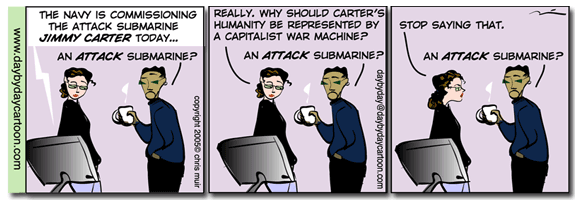
Update2: Jay Tea at Wizbang posts “What's In a Name?” sneering at our antics but also relating an amusing history of ship-naming in the United States and England.
Josh Poulson
Posted in category “Pictures, Politics” Wednesday, Feb 16 2005 05:00 PM | Permalink | 3 comments | No trackbacks
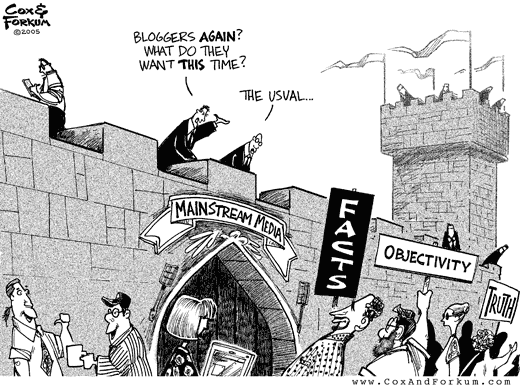
What's there not to like about this? What drew me to blogging in the first place was a chance to point out what was wrong with the news. Working in the computer industry, being interested in firearms, and pretty much being a voracious law, history, and policy buff, I see how often the press gets things wrong. Half the time I wodner if it's deliberate. Cox & Forkum sum it up pretty well for me with this cartoon.
Amazon.com links:
Josh Poulson
Posted in category “Blogging” Wednesday, Feb 16 2005 04:17 PM | Permalink | No comments | No trackbacks
The car bomb assassination of Rafiq Hariri, the former Prime Minister of Lebanon, on Monday has certainly drawn some negative attention to neighboring Syria. Of course, this neighboring country has been occupying Lebanon in some form for three decades, but it has not always carried the perception as a state sponsor of terrorism.
The first paragraph in the Washington Times article, “U.S. Recalls Envoy From Syria” illustrates this recent, but unsubstantiated, belief as it relates the recall of the US Ambassador to Syria:
The Bush administration turned up the pressure on Syria yesterday, recalling the U.S. ambassador for “urgent consultations” in Washington, but it stopped short of accusing Damascus of being behind former Lebanese Prime Minister Rafiq Hariri's assassination in Beirut on Monday.
We may have stopped short, but we were not unclear in the rest of our rhetoric:
Nevertheless, Secretary of State Condoleezza Rice said Mr. Hariri's assassination was the “proximate cause” of Ambassador Margaret Scobey's return and that Syria's “stated reason” for its de facto occupation of Lebanon “the country's internal security” is no longer valid.
Why do we allow Syria to occupy Lebanon again? Many may remember their civil war in 1975–1976, incited by clashes with the Palestine Liberation Organization (PLO). While their refugee camps along the border with Israel had been unmolested by previous agreements, their incursions into Israel drew retaliatory raids. The Encyclopedia Britannica described the growing civil war thus:
Hardly a day passed after the beginning of full civil war in April 1975 without a battle somewhere in Lebanon. The country was torn apart, and the central government virtually ceased to exist. The army, long the mainstay of the government, largely dissolved while the combatants, amply supplied by various foreign groups, turned upon one another with a ferocity—and firepower—almost unequaled in such a small area of the world.
This disastrous time for Lebanon led to an unlikely coalition between Syria and Israel supporting the Christian faction in Lebanon over the pro-PLO forces there. Syria did not want a Israeli intervention in a county on their doorstep. In 1976 Syria occupied Lebanon with 20,000 troops, partitioning the country until a longer-term solution could be found. The continued foreign intervention prevented full-scale open war, but the country was ruined regardless.
Even so, Israeli intervention came in 1981, when they bombed PLO headquarters in West Beirut. in 1982 they invaded and pushed the Syrians back.
Under supervision by an international (U.S., French, and Italian) force, PLO leaders and troops left Beirut for a number of Arab countries in late August. Because Syria supported the PLO forces remaining in northern Lebanon and in al-Biqa' valley, the forces could not be compelled by Israel to leave, but the Syrian backing was used to foster a PLO leadership that opposed the PLO chairman, Yasir 'Arafat.
Eventually the Israelis left after the situation again deteriorated and partitioning of the country (perhaps even engulfment) again loomed.
Lebanese of nearly all factions and groups rejected the possible disappearance of their country. Instead, the chief issue became which one of the groups would dominate a newly reunited Lebanon. In March 1989 General Aoun launched a “war of liberation” against Syria and its Lebanese allies; despite Iraq's covert assistance, this war failed, and in September Aoun accepted a cease-fire.
With Syria back in control and forcing political changes, the parliament was reconstituted to force power sharing between the Christian and Muslim factions. This gave them a buffer between their country and Israel. After all, who wants terrorists striking a powerful enemy from your own territory?
Since then the country has had an uneasy balance of Sunni, Shiite, and Christian factions. It was during this time that Rafiq Hariri came to power and worked hard to revitalize the country and its economy. Hariri wasn't entirely influential however, as Fox News reports, Syrian occupation has continued for many years:
Syria has an estimated 15,000 troops in Lebanon and has been adamant about keeping them in place, despite demands for withdrawal by the late Hariri and others, including the U.S. and the United Nations. U.N. resolution 1559 was passed in attempt to get Syria to leave Lebanon, to no avail.
An estimated 200,000 people came to Hariri's funeral, many of them yelling “Syria Out” as an indication that they suspected who might have been behind the bombing. Hariri's ability to unify the various factions was evident in the funeral:
Breaking with Islamic tradition, hundreds of weeping women waving white handkerchiefs joined men in the march. This and the participation of Sunni Muslim clerics, white turban-wearing Druse religious leaders and ordinary Lebanese Shiites and Christians demonstrated Hariri's great popularity and ability to reach across potentially volatile sectarian divides.
Why was he no longer part of the government? Because of his distaste for Syria's influence:
Hariri resigned last year amid opposition to a Syrian-backed constitutional amendment that enabled his rival, the pro-Damascus [Emile] Lahoud, to extend his term as Lebanon's president.
Secretary of State Condoleezza Rice had some tough talk in her comments about the recall of the ambassador.
“We are not laying blame; it needs to be investigated,” Miss Rice said.
“When something happens in Lebanon, Syria needs to help to find accountability for what has happened there,” she said. “This is a part of the destabilization that takes place when you have the kind of conditions that you do now in Lebanon thanks to Syrian interference.”
Sounds like an echo of Hariri, doesn't it?
Syria has already been on our short list, from remarks made by President Bush in the State of the Union address this year, to the Syria Accountability Act.
The Syria Accountability Act, which Congress passed in May, banned all U.S. exports to Syria except for food and medicine, as well as flights between the two countries. Some on Capitol Hill, however, have been pushing for prohibiting all American investment.
An editorial in the Wall Street Journal entitled “Syria's Dead Hand” called the Syria Accountability Act all but a paper tiger, but did add this:
In January, former Deputy Secretary of State Richard Armitage went to Damascus, ostensibly to read Bashar Assad the riot act. But we're told his main message was a demand that the Syrians hand over Saddam's half-brother Sabawi Ibrahim Hassan (a.k.a. Sabawi the Tikriti), who is almost certainly supporting the insurgency [in Iraq] from Syria. Damascus has yet to cough him up, though now perhaps it might in an act of token cooperation.
The editors of the WSJ want the recall of the ambassador to be permanent and for significant diplomatic pressure to be applied to end the occupation of Lebanon. All of this would have to be under threat of direct action from the United States. With the recent policy of pre-emption, it has to be having some effect on Syrian politics.
To be fair, lots of scandal has been heaped Syria's way since before the Iraq War. It has been rumored that personnel, valuables, and WMD was rushed over the border before and after the war started. The discovery of chemical weapons in Jordan in the hands of Al-Quaeda was supposedly through this link. In fact, Iraq-to-Syria smuggling was an open secret that perhaps US Intelligence had a pretty good eye on, but didn't thwart in order to maintain our tabs.
At any rate, if the intention of the terrorists was to provoke a reaction, they've succeeded. If they wanted to build unrest, they've succeeded. The real question now is whether the situation can be resolved and whether Lebanon will ever return to being an inclusive democracy that had Shiites, Sunnis, and Christians working together, before it was undone by the PLO.
Update: Captain Ed, at Captain's Quarters, adds his own comments in “Who Killed Rafik Hariri?.” One comment I particularly enjoyed was
So why would the Syrians want to assassinate Hariri? Well, they claim they didn't, and instead blame the Israelis. However, the Israelis have even less reason than Damascus to pull such a stunt. They want the Syrians out of Lebanon, not to give them a reason to dawdle. Besides, car bombs aren't Israel's style. The Syrians need to ensure that they have a firm political grip on Lebanon if they ever intend to leave it to the Lebanese, and with the recent push for the end of the occupation, the Syrians may have decided—rather unwisely—that a message had to be delivered in preparation for their evacuation.
I didn't delve too deeply into motivations myself so I'm glad to hear this insight.
Josh Poulson
Posted in category “Politics” Wednesday, Feb 16 2005 12:03 PM | Permalink | No comments | 1 trackback
In general, I hardly ever ask for anything for Father's Day, Birthdays, or Christmas because what I like is so doggone expensive. I also don't like disappointing the kids because they try pretty hard to find soemthing I like but don't have. The last time I asked for something I specified the Model 1 from Guncrafter Industries. Silly me, no one is going to spend three thousands dollars on a present!
Today, however, I ran across the Mackie Spike. I helped build a recording studio about a decade ago, and I liked a lot of it. Obviously I came at it from the “high tech” angle, but at the time I did a lot of the “low tech” parts like building walls, pulling cable and laying insulation.
With a Spike I suspect I'd play with podcasting if I found a reasonable but inexpensive microphone to work with, for example. Misty keeps harassing me to pick up and play my guitar again, as well.
So, why do I like the Spike? Because it offers a lot of recording power in a small, low-priced package. If we spent too much we'd all kick ourselves. This also reminds me of my old Mackie mixers and other studio toys.
Oh well, I had better stop dreaming and head home.
Amazon.com links:
Josh Poulson
Posted in category “General” Monday, Feb 14 2005 02:16 PM | Permalink | No comments | No trackbacks
A lot of bloggers are posting rants about Valentine's Day today, ranging from calling it VD to hating rampant commercialism. I have to admit that I was never a big Valentine's Day fan myself, inspired from an early age by the obligatory schoolroom antics that the girls loved and the guys hate. Girls back then loved to see boys squirm. During the few precious years they mature faster than boys do they have power over them. Others are lonely this time of year. It's easy to see why many people hate Valentine's Day.
I'll admit that I was still a little cynical last year and got in trouble for not making a bigger deal about Valentine's Day. To me it was a a day celebrating the death of Saint Valentine, who created a phenomenon by writing love letters to the daughter of his jailer. Why celebrate love one day a year? I pay attention to my wife every day, not some random cold rainy day in February.
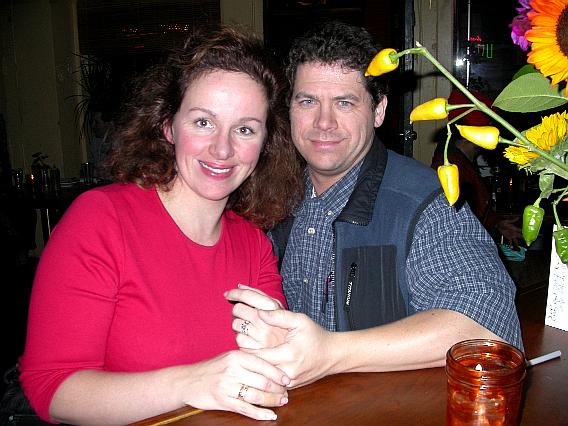
(Photo by John McEnroe at the Tugboat Brewpub in downtown Portland, OR)
I'm not going to be like that this year. I just had a weekend getaway with my wife, Misty. We disappeared to a place more symbolicly romantic than anything. It was all about spending some time together without too many outside distractions, getting to do things we don't otherwise get to do. (That means watching movies for people over the age of 8.)
At the end of it we ventured out and watched Hitch in the theaters to top it all off. It was simple innocent fun. Also, it was contrived like most romantic comedies are. We enjoyed it anyway. Normally that sort of stuff sickens us.
I love my wife. I had a wonderful weekend. There are moment I wish would never end. If that's what we celebrate at Valentine's Day then I'm all for it. If it's all about chocolate, cards and presents I'm another curmudgeon and cynic like everyone else.
Josh Poulson
Posted in category “General, Pictures” Monday, Feb 14 2005 09:05 AM | Permalink | 1 comment | No trackbacks
Again, from a GOAL alert, anti-gun bills in Washington. Much of the data is the same, but there are three new house bills below.
| Senate bills | ||||
| # | Blurb | Sponsor | Status | Position |
|---|---|---|---|---|
| SB 5041 | Sentencing range | McCaslin (R-4) | S. Jud. | Neutral |
| SB 5131 | Insanity finding/firearms | Carrell (R-28) | S. Jud. | Neutral |
| SB 5167 | Firearm suppressors | Hargrove (D-24) | S. Jud. | Support |
| SB 5342 | Safe storage of firearms | Kohl-Welles (D-36) | S. Jud. | Oppose |
| SB 5343 | Gun show loophole | Kohl-Welles (D-36) | S. Jud. | Oppose |
| SB 5344 | Capitol campus gun ban | Fairley (D-32) | S. Jud. | Concerns |
| SB 5383 | Juvenile hunting licenses | Oke (R-26) | S. NatRes. | Neutral |
| SB 5475 | Assault weapon ban | Kline (D-37) | S. Jud. | Oppose |
| SB 5545 | Deployed military CPL renewal | Roach (R-31) | S. Jud. | Support |
| SB 5593 | .50 BMG rifle ban | Kline (D-37) | S. Jud. | Oppose |
| SB 5635 | Restoration of rights | Schoesler (R-9) | S. Jud. | Support |
| SJM 8005 | Manufacturer protection | Benton (R-17) | S. Jud. | Support |
| House bills | ||||
| # | Blurb | Sponsor | Status | Position |
| HB 1133 | Public disclosure law | Nixon (R-45) | H. StatGov. | Neutral |
| HB 1213 | Juvenile hunting licenses | Clements (R-14) | H. NatRes | Neutral |
| HB 1473 | Safe storage of firearms | Moeller (D-49) | H. Jud. | Oppose |
| HB 1489 | Capitol campus gun ban | Williams (D-22) | H. Jud. | Oppose |
| HB 1490 | Park/rec area gun ban | Darneille (D-27) | H. Jud. | Oppose |
| HB 1627 | Assault weapon ban | Kagi (D-32) | H. Jud. | Oppose |
| HB 1687 | Insanity finding/firearms | Moeller (D-49) | H. Jud. | Neutral |
| HB 1804 | CPL renewal notification | Ericksen (R-442) | H. Jud. | Support |
| HB 1822 | Lead shot hunting ban | Kagi (D-32) | H. NatRes. | Oppose |
| HJM 4002 | Manufacturer protection | Curtis (R-18) | H. Jud. | Support |
There will be a hearing on HB 1822 on February 15th at 1:30pm. The hearing will be in the John L. O’Brien Building, Hearing Rm “D”
Josh Poulson
Posted in category “Guns” Saturday, Feb 12 2005 12:03 PM | Permalink | No comments | 1 trackback
I bit the bullet and set up Google AdSense. Perhaps some of you might claim I've sold out since I've had no advertisements on my web site since 1995, unless you count the links to Amazon.com books and DVDs. However, as my traffic goes up I need to be defensive about the change that Kira (who wrote the books CGI 101 and CGI 201) and Brad will start charging me more for being hosted on cgi101.com.
So, on every static page, the ads will appear on the bottom of the main column, after all the content. I was tempted to put the ads in before the comments form for individual pages, but even that seemed too much. I also added a Google search, although I prefer A9 myself. However, A9 doesn't have a search box.
To date I've made $2.52 on Amazon.com links after being an Associate for a month. Already today I've had more then 60 Google ad impressions. Not quite enough to pay my hosting bill, but that's hardly a problem.
Amazon.com links:
Josh Poulson
Posted in category “Blogging” Friday, Feb 11 2005 02:20 PM | Permalink | No comments | No trackbacks
We arrived late, but Misty and I attended the 2/10/2005 Election Reform Task Force Meeting down here in Clark County. While I didn't get up to speak because everyone else was doing such a good job, I did get to see what everyone else was doing. (If anyone else was there reading this, I was apparently the only on present with a blaze orange collared shirt.)
There were a lot of orange shirts there. Around 150 concerned citizens, many of whom were wearing orange bandannas, armbands, or clothing, got up to testify about how disillusioned they were with voting in the state of Washington. There was also a noticeable amount of press, scribbling quickly in their notebooks.
It was a peaceful assembly. Many opinions were brought out. Not everyone was for a revote, but many were. A contingent from the Green Party talked about Instant Preference Balloting and were heard politely. A few people involved in working with the election had suggestions, too.
Military ballots and the revote and the troubles in King County were all aired multiple times. Solutions were offered, many reminding me of the list of suggestions from the Evergreen Freedom Foundation.
One gal wondered aloud if we would be there if the results of the election had been different. I have to say that if the election was broken but had gone my way I probably wouldn't have been as passionate about being there, but I dislike broken election systems. I have a long history of that.
Don Carlson brought up the issue of accurately counting the votes of those in assisted living, which made Misty happy. Other representatives were there as well, like Rep. Curtis.
One response I heard, more than once, is that if a revote were to occur with the current broken system similar results could be expected. I have to agree with that. Secretary of State Sam Reed said that the judge in Chelan County admitted that he could not force a revote, but he could vacate the governorship, requiring that it be filled at the next regular election.
Our favorite Sam Reed quote was that it was not time to rearrange the deck chairs on the Titanic. I have to agree. Voter confidence was not very good with the crowd that was there.
All in all, it was a good time. We'll have to see if the other meetings go as well.
Update: Andrew Garber of The Seattle Times was there and has filed a report.
More than 100 people showed up at a Clark College auditorium to vent their frustration to the four-member task force chaired by Reed and former Democratic state Sen. Betti Sheldon. Comments ranged from technical advice to outrage.
Bill Stewart of The Oregonian also reported on the events last night:
Most of the estimated 100 people attending the hearing at Clark College called for a revote, but members of the Green Party asked Reed to endorse an “instant runoff vote” in which candidates are ranked by voters, then the second choices are used if the tally is a tie. A bill has been introduced in the Legislature to allow that system in Vancouver city elections.
I'm pretty sympathetic to instant runoffs elections myself. One person said that they didn't want an Ireland here because of the multiple factions and other problems overseas. I didn't get a chance to point out that those problems come from the parliamentary system, not instant runoff elections.
Update2: Vancouver's The Columbian has an article by Tom Vogt.
Josh Poulson
Posted in category “Politics” Thursday, Feb 10 2005 09:16 PM | Permalink | 3 comments | No trackbacks
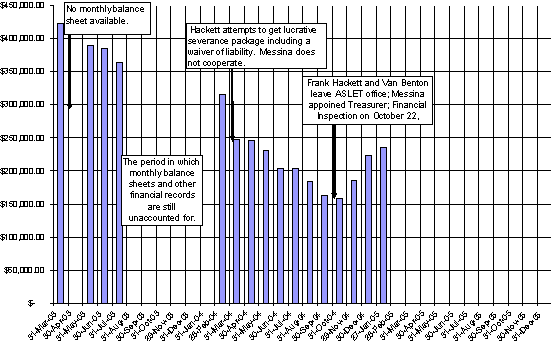
I've been re-upped for another term in the ASLET Bylaws Committee. In addition, I've been appointed to the Finance Committee.
More fun extracurricular work awaits! I'm sure one of the things to look at is this one (from ASLET Updates):
Josh Poulson
Posted in category “” Thursday, Feb 10 2005 07:11 PM | Permalink | 1 comment | No trackbacks
Poking around the search engines, I noticed my picture of my Bushmaster XM-15 has gone way down in rank on Google's image search. After the arrest of Lee Malvo, I got thousands of hits on pun.org because of my picture, linked to below. Not that I'm celebrating anything Malvo did, I'm not, but I thought it was interesting that my rank was so high then, and so low now.

(click on this image to get the full-size version)
Nowadays my Bushmaster looks a little different. I changed out the trigger with a Chip McCormick Super Match Trigger Group with the help of trusty gunsmith John McEnroe. Also, I have a ambidextrous safety which is useful for left-handers like myself.
Misty's AR has the trigger group change, but not the ambi-safety.
The only other big differences are that I got a .22 LR upper, in the A2 configuration, for target shooting from Fulton ARmory. I definitely recommend Fulton ARmory for AR-15 parts. I haven't had a chance to try their work since John is so much closer to home.
Josh Poulson
Posted in category “Guns, Pictures” Thursday, Feb 10 2005 06:10 PM | Permalink | 1 comment | No trackbacks
The initial flurry of Carly's exit stories yesterday is dwarfed by the prodigious output of armchair quarterbacking this morning. The Wall Street Journal, Business Week, the Economist and even regular news outlets have stories this morning. What caught me by surprise, though, was a piece in today's MIT Technology Review entitled, “Worst. CEO. Ever.”
It's pretty harsh.
There was little love lost between the CEO and the 151,000 HP workers who have, almost consistently since 1999, made hating their boss a very personal, full-time mission.
“When the news was officially announced this morning, people were dancing—literally dancing—around their cubicles,” an employee in the business division writes in an email.
Why is there so much hated of Carly inside the company? After all, the Board of Directors has done nothing to change the strategy that many feel has led to HP's problems. As The Economist is saying today,
The ousting of Ms Fiorina therefore does not automatically mean that a break-up is now likely. The same board that has decided against it three times already, and this week pledged allegiance to HP’s strategy—whatever that is—will now be looking for a new chief executive.
Carly was a key driver of combining businesses inside HP. Recently she drove the merger of the PC and Printer business units, which would hide the poor performance of that division in the profits of the only truly profitable part of the company.
Part of the reason HP is up in the market now is that many feel the key person arguing against a break-up of the company is now gone, and therefore it is likely to split up.
Other may believe that innovation will return as a HP strategy. As MIT Technology Review put it:
Fiorina's obsession with Wall Street pushed much innovation to the side, and eventually led to a rather unsettling change in the HP work environment: the company's very first layoffs. When it was all said and done, 15,000 of the then 85,000 workers found themselves without a job by the end of 2003.
However, if the 80's and 90's taught us anything, one cannot be a lean-mean fighting company and have a culture of entitlement and continuous employment. Carly's head was in the right place in one respect:
“After a period of integration, cost-cutting, returning our businesses to profitability and returning to top line growth, we enter fiscal year 2005 knowing that we have the right strategy, play in the right markets and offer the right portfolio of products and services,” Fiorina writes. “We are now focused on consistency of execution and consistently delivering financial performance, great customer experiences and shareowner value.”
She's right. One has to build shareholder value to make the investors happy. However, it's only one of the many levers of managerial control. One also has to innovate in order to maintain growth long-term. I believe she tipped the balance too far. HP was not about to go bankrupt. It still needed to invest in forward-looking projects as well as cleaning up the bottom line. Apparently the employees agree:
And her reluctance to embrace research and development of emerging technologies, consistently creating new and better markets as only Hewlett-Packard could, alienated her from the company.
According to BusinessWeek's “Inside Story” of the firing of Fiorina, she was good at passion and marketing but lousy at strategy,
Sure, she had dazzled directors and many investors with her passionate work in pushing through the controversial merger with Compaq Computer in 2002. And the immediate integration of the two companies bested expectations, silencing even her fiercest critics. But by late 2003, investors began shifting their focus from the Compaq deal to HP's ebbing position against key competitors IBM and Dell. They bored in on the ragged financial performance that led to the swooning stock price.
“[Fiorina's] good with marketing. She's a good speaker for the company,” says a former HP executive. “But this is a company that doesn't need a statesman. It needs a hands-on operations person.”
The story keeps coming back to execution, specifically the speed at which she needed to change the business. She was slow to fight the incursion of Dell and IBM (who I readily admit working for, although I try to keep their business out of my writing here). She was slow to execute on a possible acquisition of Veritas Software, Inc.
Financial performance is definitely important, compared to the industry:
The management ouster at HP gives the company a chance to rebuild trust with investors. During Fiorina's 21 quarters atop HP, it missed profit expectations eight times. Sure, that's better than the 21 quarters before Fiorina arrived. But it's also more than double the combined misses of IBM and Dell over the same period.
However, Business Week doesn't believe it was just execution that is causing HP's funk, however:
While it's convenient for HP's leaders to blame poor execution for their problems, what ails the company runs much deeper than replacing a few top executives. In enterprise computing, HP has failed to improve its lot. While it is still narrowly holds the market-share lead in storage and in key server markets, including Unix and PC servers, it's losing ground to EMC in storage and Dell and IBM in servers. In some cases, its technology just hasn't kept up. In others, it has made bad bets.
The biggest failure, in my opinion, was Itanium, as I've mentioned here before.
As a result the board talked to her more and more in hopes of getting her to delegate operational activities to her executives and she was reluctant to do so. Remember that she fired three executives for a bad quarter just half a year previously. She also drew some criticism for twice rejecting an opportunity to establish a chief operating officer to handle the tasks of execution. As a result, by not delegating, she took the brunt of the bad year herself.
I think it's telling that HP's CFO, Robert P. Wayman, is now the interim CEO. That indicates to me that the board is interested in shoring up its financial position and hopes that Wayman will execute on what strategy remains at HP. However, it's the perfect person to have in charge if breaking the company up is in the future.
The front runner for replacing Fiorina is Michael A. Capellas, currently running MCI, but notable as the executive that sold Compaq to HP in the first place, and served as a VP for a short while in the giant company. However, we'll have to see if the half a year it takes to find an executive yields fruit or if the company is sliced and diced into smaller, faster, companies that have to struggle to find revenue.
If you're a subscriber and you have a lot of time, the Wall Street Journal has comprehensive coverage of the situation. Me, I need to get back to work.
Update: With a pointer from Prof. Jack Raiton, I discovered a Financial Times article that points out changes in the Board of Directors at HP hastened Fiorina's demise.
Dick Hackborn, the HP director and former executive responsible for creating the company's hugely successful printing business, probably played a key role in the behind-the-scenes manoeuvrings that led up to Carly Fiorina's removal, according to close observers of the company.
So Hackborn was her main source of support, but her other supporters started leaving a year ago:
Other boardroom moves have also served to weaken Ms Fiorina's position. Sam Ginn, who had led the search committee when she was hired and had been one of her staunchest supporters, left the board a year ago, along with Phil Condit, the former Boeing chairman who had also been a supporter. Mr Ginn and Mr Condit had also steered the board's nominating and governance committee, a key inner group with influence over the composition and workings of the board.
Two more changes cemented the deal. First, she lost another supporter:
Recent signs pointed to a more rapid shift in the balance of power in the boardroom that finally stripped Ms Fiorina of support. Sandy Litvack, who as a former general counsel of Walt Disney had shown strident public support for embattled CEOs in the past, quit unexpectedly as an HP director at the start of this month - just weeks before he was due to retire.
…and she gained an enemy:
Then this Monday, the day before Ms Fiorina was dismissed, Tom Perkins, a former Compaq director and one of Silicon Valley's most eminent venture capitalists, rejoined the HP board a year after retiring allegedly for age reasons.
You have to keep the board happy if you want to continue being a CEO. When the board changes you have to move fast. “Moving fast” was not at the top of the list of Carly's strong points.
Josh Poulson
Posted in category “Business” Thursday, Feb 10 2005 08:37 AM | Permalink | 1 comment | No trackbacks

(photo by John McEnroe or Dan Sweet, at this point all of their work has been mixed up in my storage)
Sometimes a reason to go on vacation again to inflame fond memories. I have no idea what the joke was that Dan made at this moment, but clearly we had different reactions to it. Obviously I liked this a great deal better than when we were doing portraits standing on a anthill.
Josh Poulson
Posted in category “Cruising, Pictures” Wednesday, Feb 9 2005 01:49 PM | Permalink | No comments | No trackbacks
I just got a note from the folks that run the revotewa.com web site…
Dear ReVote Washington Supporter:
The past month has been an intense and fulfilling exercise in direct democracy.
The Revotewa.com site went “live” on December 31, 2004 and with only word of mouth—the petition had 5,000 by New Year's Day. The next day Revotewa.com's petition had 10,000 signers—by that week's end the petition had 135,000 signers.
Yesterday, February 3, 2005 we turned in over 241,000 petitions asking the Legislature of Washington State to order a re-vote of the Governor's race.
We submitted the original 8.076 paper petitions and a CD containing the name, address and city of all 233,647 cyber petitioners to the Counsel for the House (Tim Sekerak). We also submitted a copy of the petitions and a CD to the Counsel for the Senate (Marty Levenger) yesterday at 1 p.m. in Olympia.
Both Counsel have informed us that the petitions will be considered public documents. The Legislators will be able to access all documents as they wish.
So, aside from the nearly quarter million Washingtonians who signed on with you, where does the entire state as a whole stand on re-vote?
Various organizations and media outlets throughout the month have conducted opinion polling and while the question varies, Washington voters have made clear they want the “election mess” fixed with a revote. The Survey USA poll (posted on the site under “Opinion”) had these results this week:
Regardless of who you voted for in November’s gubernatorial election, would you favor another election for governor to resolve the election?
Yes: 53%
No: 35%
Undecided: 12%
As a majority of state citizens clearly are still demanding a re-vote we are going to keep our website alive to help facilitate that effort.
So far we have raised just under $43,000 and spent close to 90% of that on TV spots asking for a re-vote. As we may need to raise our media campaign again in the wake of upcoming court decisions, please consider making a small donation—we will put it to good use.
In any case, thanks again for your support…and keep up the letters, emails and word-of-mouth with your family, friends, and especially your TV, radio and newspapers. A re-vote will only happen if we make it happen!
Thank you!
Sharon Gilpin
The Gilpin Group
www.thegilpingroup.com
Josh Poulson
Posted in category “Politics” Tuesday, Feb 8 2005 04:39 PM | Permalink | 2 comments | No trackbacks
BusinessWeek Online has an article, “After Sarbanes-Oxley, XBRL?” discussing Extensible Business Reporting Language (XBRL) and its effects on the financial reporting industry.
As a little bit of background, XBRL was announced by the American Institute of Certified Public Accountants (AICPA) jointly with Reuters and over thirty other organizations as a standard way to release computer-readable financial statements to the public. What is it's key value? The ability to determine the source of information in the released documents.
XBRL tags financial information so it, too, can be tracked, from the first interactions with vendors, to reports submitted to various operating divisions within a company, and finally to become part of a consolidated earnings release.
That's the core technology. What's the promise?
Eventually, XBRL will be the foundation for a whole new generation of financially oriented Web services that will make it easier for regulators to check for problems in financial data, executives to compare their company to competitors, and analysts to identify the best-performing stocks.
While it's a long time before modern financial data movers reach those ethereal heights, online services such as Edgar Online are offering tools to work with the data and software vendors like Rivet Software offer tools to sift financial documents for data that can be transformed into XBRL.
The adoption of the XBRL standard has not been made mandatory by the SEC, and the competition is already nervous. Standardization signifies a significant market change for companies like Standard & Poor's with their Compustat offering. S&P does their own data extraction and analysis, but if extraction gets easier then the value proposition leans towards the one with most comprehensive set of tools. The data extraction part would cease to add value.
At the moment the XBRL adoption process is hung up in committees trying to settle the standard. Extensive negotiations between competing software vendors, financial experts, and company CFOs has not produced a coherent standard. It may be up to the SEC, through the Financial Accounting Standards Board (FASB), to come in and adjudicate the various disputes.
Even so, progress has been made. In the past few months major decisions have been reached on the major “taxonomies” (essentially, the standard tagging structure for various types of industry) under discussion.
Now 90% of companies are covered, while extensions of XBRL for specific industries, like oil or banking, are still being developed.
On February 3rd of this year, the SEC adopted a rule establishing a voluntary program for publishing XBRL data on Edgar:
The primary purpose of the voluntary program is to assess XBRL technology, including both the ability of registrants to tag their financial information using XBRL and the benefits of using tagged data for analysis.
Many voluntary programs with the SEC become mandatory if successful. Like the recent roll-out of Sarbanes-Oxley, XBRL could be the next financial reporting resource crisis.
Josh Poulson
Posted in category “Business” Tuesday, Feb 8 2005 02:12 PM | Permalink | No comments | No trackbacks
So, President Bush has submitted his budget for the 2006 fiscal year of the United States Government. Congress will now hem, haw, hack, and cough up the money for another year of “the Feds.”
So, what's in this 2.57 trillion dollar beast? This is a 3.6% increase over the last fiscal year.
We start with tough talk about restraint from the Press Briefing for the release of the budget:
Because of this increased spending restraint, deficits are below what they otherwise would have been. In order to sustain our economic expansion, we must exercise even greater spending restraint than in the past. When the federal government focuses on its priorities and limits the resources it takes from the private sector, the result is a stronger, more productive economy. The President's budget proposes that enhanced restraint.
How much of that is true? The Wall Street Journal reporter Shailagh Murray says,
Fiscal conservatives will find the most to like in Mr. Bush's plan. While administration documents describe the cut in non-defense, non-homeland security domestic discretionary spending as a 1% reduction, the real cut is about 2% when the numbers are adjusted to take out foreign aid.
Seems reasonable. Again, how much of this is true. Chris Edwards and Alan Reynolds Op Ed in the Wall Street Journal is less rosy:
At first glance the budget sounds pretty tough this year, with a promise to cut or terminate 150 federal programs. But even if Congress passed all those cuts, 2006 spending would be reduced by less than 1%. Last year's budget likewise proposed terminating 65 programs, but only five were actually ended.
Let's look at the technology side of the fence, one of my interests. ZDnet's Russel Shaw highlights four measures in the budget that got his attention. The patent and trade office gets a 10% increase. The National Institute of Standards and Technology (NIST) gets a 7.5% increase. The Federal Communications Commission (FCC) gets a 6.5% increase. Finally, the National Science Foundation (NSF) would get a 2.7% increase. Seems to me like a decent focus on infrastructure although a barely ticking promotion of basic scientific research. It's my hope is that this will spur businesses to get more involved in basic R&D.
It's been said that the good thing about this budget is that with deficit spending there's far more pressure to cut bad programs and trim fat budgets. While this is a decent approach to keeping the legislature under control, it does nothing to save us from a tax-and-spend executive taking the reins in four years.
Democrats are already howling. On some issues they are right to complain. This budget holds aside the issues of changing the Alternative Minimum Tax (AMT) which is not inflation-adjusted and is therefore affecting more individuals and businesses each year. The other is the costs of changing the Social Security System.
I'll keep an eye out on what Congress changes. More later…
Josh Poulson
Posted in category “Politics” Tuesday, Feb 8 2005 12:40 PM | Permalink | No comments | No trackbacks
Today I took the trouble of labeling pages on my site for Internet Content Rating, per the ICRA. I had to self-rate my content to general a “label.”
The label I generated label declares that this web site discusses or depicts:
So perhaps my site is a tad controversial in these terms, but I think I made an honest attempt labeling it.
Part of the fun was having their tester find all the external stuff I was linking on my site. I fixed most of that mess and I think the pages will even load more quickly because most of the images come from my site now. It is a bit goofy to load a single icon from another web site.
Josh Poulson
Posted in category “Blogging” Tuesday, Feb 8 2005 11:08 AM | Permalink | No comments | No trackbacks
An alert that came my way from the Clark County GOP…
Vancouver is the first stop of four to be made around the state. Come and join us for a rally and provide constructive input on election reform at this public hearing next week! Wear something orange. We encourage you to bring constructive homemade signs and any revote signs you may have. The greater the attendance, the greater the message!
| What: | Task force appointed by temporary Gov. Gregoire will take public comments on improving elections. |
| Who: | Secretary of State Sam Reed, former state senators Betti Sheldon and Larry Sheahan, and former Washington State University President Sam Smith comprise the task force. |
| When: | 6:30 to 8:30 p.m. Thursday Feb. 10, 2005 |
| Where: | Clark College
Foster Auditorium 1800 E McLoughlin Blvd., Vancouver |
Please remember that this is a peaceful rally as we are a peaceful Party!
Approved By: Josephine F. Wentzel, Political Director, Clark County Republicans
Suggestions: One of our Elected Officials suggested that we come early and register inside to ask questions at the public meeting, as this is a very controlled one. The following issues were suggested to bring up, so chose one. (It doesn't matter if the same question is asked 30 times).
When you attend, please stick to the following subjects. Other points will be addressed in Olympia. But these will be left out unless you stand up and demand change.
Other facts and figures to use:
Josh Poulson
Posted in category “Politics” Monday, Feb 7 2005 11:51 AM | Permalink | 2 comments | No trackbacks
Since election reform is a hot topic in Washington, I figure I should throw in my suggestions. At the moment I'm a permanent absentee voter because I work in Oregon, 38 miles from my home. Obviously spending the 2–3 hours necessary to come home and head back to work in the middle of the day is out of the question for me.
Or is it?
I agree with L. Neil Smith. Voting should be inconvenient. It should never be trivially easy to give your rights away. It should never be the case that people vote without really understanding what they are voting for.
For example, here's what he thinks about majoritarianism, from an essay called “The Tyranny of Democracy”:
Some claim that majoritarianism, despite its faults, is an alternative preferable to physical conflict. They're wrong: majoritarianism is physical conflict. Elections are a process of counting fists, rather than noses, and saying, “We outnumber you—we could beat you up and kill you—you might as well give in and save everyone a lot of trouble.” Majoritarianism, to put it straightforwardly, possesses the full measure of nobility manifested by any other form of extortion.
He goes so far to point out that the best system is one where those who haven't voted for something can opt-out of the effects of whatever was voted in, similar to those who order pizza as a group.
That's pretty far afield. However, a piece of that analogy holds. Trying to be all things to all people often results in bad decisions. If everyone is forced to abide by bad decisions people are dissatisfied with the result. It should be harder to make bad decisions.
So I oppose vote-by-mail. I oppose vote-by-phone. I oppose vote-by-Internet. I don't oppose mechanisms that make voting more accurate, but I oppose mechanisms that make voting easier. Not because of the security risks of these remote voting schemes, which are certainly tangible, but because when it is too easy to vote people don't pay attention.
People who know me recall that I prefer bodies divided by multiple factions and the requirement of a supermajority to pass measures that usurp the rights of the membership. I always err in favor of having a minority voice be heard, but I also always favor having rights be retained by the membership. For example, I push for members having the final say on bylaws changes, not some shadowy board. This is a foreign concept to the OHSU Student Council. It's held with some skepticism by ASLET.
In Oregon and Washington the initiative process is pretty strong, but has been hamstrung. In Oregon there is a less-than-ethical Secretary of State, Bill Bradbury. In Washington we have the “emergency” clause that I mentioned here before.
What makes me believe in voting is how much people have tried to circumvent bad laws by changing them directly through the initiative and referendum processes. Perhaps what we need to change in the Constitution is the concept of inertia. it should be hard to add things to law, and easy to remove them. I'm not talking just line-item veto stuff. I want bad laws to go away automatically.
A long time ago I suggested the idea of expiration dates based on the how large a majority a law enjoyed. For example, a unanimous law like outlawing murder would have a one hundred year lifespan and would need renewing infrequently. A popular law with 75% support, like the outlawing of gay marriage, would last fifty years. A barely tolerable law, like a tax increase, just eking out at 51%, would last until the next legislative election (two years in some states, six years for the Senate).
At any rate, the reason I mention L. Neil Smith is my memory of a meeting of the Confederate Congress in The Probability Broach. The location of the congress was in the middle of nowhere, because it made it harder to vote. Admittedly, it also featured a proxy-voting system that made it easier to vote as well, so maybe the Confederacy isn't perfect either in his utopia. Stories about perfect worlds are boring, anyway.
Amazon.com links:
Josh Poulson
Posted in category “Politics” Monday, Feb 7 2005 10:41 AM | Permalink | 5 comments | No trackbacks
Some folks like my tables I've done (for example, on this blog I did a table on Washington gun bills, or the schedule at nwsafe.org). So, here's my attempt at a table that shows the Royal Caribbean Crown & Anchor Society benefits:
I won't be able to use my normal greenbar on this table, though, since the color of the rows corresponds to membership level.
This club is for Royal Caribbean cruisers, 18 years and older. The main things to remember is that you need 1 cruise credit to become a gold member, 5 to become platinum, 10 to become diamond, and 24 to become diamond plus. The benefits below are cumulative (which is what made their table hard to read, you couldn't tell what you would be getting at the next level).
| Affiliation Benefits | |
| Level | Benefit |
|---|---|
| All | Receive an extra cruise credit when you purchase and sail in a suite (categories RS, OS, FS, GS, JS) for sailings beginning on or after January 1, 2004 |
| All | Receive two cruise credits for a 12-night or longer cruise/cruisetour on or after January 1, 2003 |
| All | Award-winning Crown & Anchor magazine |
| All | Member section on Web site |
| All | Members contest |
| All | Member Cruises |
| All | Crown & Anchor Society desk for membership inquiries (800-526-9723) |
| Diamond Plus | Diamond Plus membership card |
| Diamond Plus | Diamond Plus baggage tags |
| Diamond Plus | Diamond Plus lapel pin |
| Diamond Plus | Extra Diamond Plus benefits available after the 49th completed cruise credit |
| Diamond Plus | Special benefit available to those valued members who reach their 100th cruise credit |
| Onboard Benefits | |
| Level | Benefit |
| Gold | Gold Ultimate Value Booklet |
| Gold | Complimentary Wine Tasting |
| Gold | Welcome Back Party |
| Gold | Commemorative gift |
| Platinum | Platinum Ultimate Value Booklet |
| Platinum | Private departure lounge |
| Platinum | Exclusive onboard event |
| Platinum | Robes for use onboard |
| Platinum | Priority check-in (where available) |
| Diamond | Diamond Ultimate Value Booklet |
| Diamond | Priority wait list for sold-out shore excursions/spa services |
| Diamond | Concierge service on select ships |
| Diamond | Priority departure from ship |
| Diamond | Priority check-in (where available) |
| Diamond Plus | Personalized amenity delivered to your stateroom or dining room |
| Diamond Plus | Behind-the-scenes tours |
| Diamond Plus | And more Onboard Benefits… |
| Cruise Planning Benefits | |
| Level | Benefit |
| Platinum | A special number to call for pre-cruise benefits, (888-437-1953) |
| Platinum | Complimentary custom air fee |
| Platinum | Special rates on balcony and suite staterooms |
| Diamond | Priority wait list for dining room seating |
| Diamond Plus | Exclusive access to Loyalty Specialist for you or your travel agent |
| Diamond Plus | Preferred seating in main dining room |
| Diamond Plus | And more Cruise Planning Benefits… |
Amazon.com links:
Josh Poulson
Posted in category “Cruising” Sunday, Feb 6 2005 12:02 PM | Permalink | No comments | No trackbacks
So, I used to have a page that had some puns on it, but I'm going to add a category to the blog for it and move those puns to this posting. As I mentioned before, I am nervous about copyrights, otherwise I'd have a lot more puns here. I get tons in email every day.
A group of chess enthusiasts had checked into a hotel, and were standing in the lobby discussing their recent tournament victories. After about an hour, the manager came out of the office and asked them to disperse. “But why?” they asked, as they moved off. “Because,” he said, “I can't stand chess nuts boasting in an open foyer.”
A doctor made it his regular habit to stop off at a bar for a hazelnut daiquiri on his way home. The bartender knew of his habit, and would always have the drink waiting at precisely 5:03 p.m. One afternoon, as the end of the work day approached, the bartender was dismayed to find that he was out of hazelnut extract. Thinking quickly, he threw together a daiquiri made with hickory nuts and set it on the bar. The doctor came in at his regular time, took one sip of the drink and exclaimed, “This isn't a hazelnut daiquiri!” “No, I'm sorry,” replied the bartender, “it's a hickory daiquiri, doc.”
A hungry African lion was roaming through the jungle looking for something to eat. He came across two men. One was sitting under a tree and reading a book; the other was typing away on his typewriter. The lion quickly pounced on the man reading the book and devoured him. Even the king of the jungle knows that readers digest and writers cramp.
There was a man who entered a local paper's pun contest. He sent in ten different puns, in the hope that at least one of the puns would win. Unfortunately, no pun in ten did.
A guy goes to a psychiatrist. “Doc, I keep having these alternating recurring dreams. First I'm a tee pee; then I'm a wigwam; then I'm a tee pee; then I'm a wigwam. It's driving me crazy. What's wrong with me?” The doctor replies: “It's very simple. You're two tents.”
A man goes to his dentist because he feels something wrong in his mouth. The dentist examines him and says, “that new upper plate I put in for you six months ago is eroding. What have you been eating?” The man replies, “All I can think of is that about four months ago my wife made some asparagus and put some stuff on it that was delicious… Hollandaise sauce. I loved it so much I now put it on everything—meat, toast, fish, vegetables, everything.” “Well,” says the dentist, “that's probably the problem. Hollandaise sauce is made with lots of lemon juice, which is highly corrosive. It's eaten away your upper plate. I'll make you a new plate, and this time use chrome.” “Why chrome?” asks the patient. To which the dentist replies, “It's simple. Everyone knows that there's no plate like chrome for the Hollandaise!”
That's all the content from the old page. I'll have to clear some more puns and post them to this category in the future.
Josh Poulson
Posted in category “Puns” Sunday, Feb 6 2005 09:26 AM | Permalink | 1 comment | No trackbacks
My previous posting on the rulings from Judge Bridges need some tweaking.
From Timothy Goddard's The Flag of the World, more interpretation:
First off, Bridges made a statement that most people appear to have missed. (I’ll have to paraphrase until the transcript comes out, probably next week.) He said, essentially, if the Republicans can prove their allegations as they have stated them, then their election contest will prevail. This is, obviously, quite good news.
I admit that I had missed this point, but I'm relying on second-hand reports in the press and on the blogosphere. for example, KGW still has the erroneous headline, “Judge says he can't order recount of Wash. governor's race,” along with a shortened quote of the ruling that pretty much hands the Democrats victory if you see it and nothing else. Also, KGW has this cute bit:
At one point, Bridges talked about one of the cases cited in the lawsuit, a late-1800s election challenge in Arkansas. Both governors had their own militia, and state Supreme Court judges were kidnapped, he said.
“We think this is not what should go on in this system” Bridges quipped, “not that I don't wish I were kidnapped so I didn't have to make these decisions.”
Back to Timothy's analysis:
Second, the he ruled that he won’t be ordering a special election because he doesn’t have the authority. Some people have said this means “no revote,” which would be pretty deadly, but that’s not exactly true. Before Bridges even made his ruling, the Republican counsel said that the question before the court at that point was not “whether” to have a revote, but “when.” That is to say, would the court be able to order an election immediately, or wait until the next general election in November? The court has essentially said that the soonest there could be another Rossi-Gregoire showdown is in November, because the court’s power doesn’t extend far enough to order a new one immediately. The likely outcome of a successful contest now would be for the election to be nullified, Gregoire booted from office, leaving it vacant, meaning that the Lt. Governor Brad Owen would take over until November. While Republicans are dissappointed with this ruling, it’s hard to be too bummed about a judge admitting that his powers aren’t infinite.
Well, with the gun bills and other fluff trying to get pushed through, I'm a little nervous about waiting until November to correct this problem in the Governor's office.
Next, Timothy and Sound Politics both point out that the Seattle Times' reporter John Postman spun things in the Democrats' favor in this article:
The good news for Democrats was Bridges’ ruling in Chelan County Superior Court that Republicans must show any illegal votes were cast in favor of Gregoire, and not Republican candidate Dino Rossi. There would have to be enough illegal Gregoire votes to erase her 129-vote victory margin.
Matt Rosenberg at Sound Politics saw something different in today's Seattle Times, amounting to a correction:
Bridges…denied a Democratic motion to limit any challenge to issues of fraud and illegal votes, saying misconduct or neglect by election officials would also be sufficient grounds for setting aside the election.
Timothy sums it up, “Republicans get the present, Democrats the bow.”
Josh Poulson
Posted in category “Politics” Sunday, Feb 6 2005 08:56 AM | Permalink | No comments | No trackbacks
I talked about SB 5475 before in this posting but I did not delve deeply into the emergency clause:
This act is necessary for the immediate preservation of the public peace, health, or safety, or support of the state government and its existing public institutions, and takes effect immediately, except for section 4 of this act which takes effect July 1, 2005.
What I didn't know before is that bills passed with this clause cannot by changed by a referendum. Per the Washington Constitution, Article 2, Section 1:
…The second power reserved by the people is, the referendum, and it may be ordered on any act, bill, law, or any part thereof passed by the legislature, except such laws as may be necessary for the immediate preservation of the public peace, health or safety, support of the state government and its existing public institutions, either by petition signed by the required percentage of the legal voters, or by the legislature as other bills are enacted…
Emergencies that have tax effects have a limited lifespan, but this one is more of an unfunded mandate than a tax. It's no small wonder they want this text in there. It's not to pass it and have it take effect immediately, it's to protect it from the significantly more pro-gun majority of citizens!
At the moment this bill is held in committee due to a power struggle between the urban and the rural Democrats. Obviously the rural Democrats don't want to lose the next election. The urban ones don't bother hiding their citizen-hating desires.
Josh Poulson
Posted in category “Guns” Friday, Feb 4 2005 04:25 PM | Permalink | 2 comments | 1 trackback
According to KGW, “Judge dismisses 39 counties from Wash. gov. lawsuit.”
What really happened? The judge has ruled on many items:
The press may try to spin this Gregoire's way, out of sympathy I suspect, but even that keeps the revote effort in the public eye.
Keep reading Sound Politics for more up-to-date information. I'm pretty far from the fight in Clark County.
Update: No sooner do I shut down my computer and head home than the judge in Chelan county rules that his court does not have the authority to order a revote. Democrats take this as a victory, but it just sets up the appropriate appeal to a court high enough to order such an action. The Republicans remain confident.
Here's an interesting note on the KGW story:
Should the Republicans prevail in their lawsuit, it was not immediately clear what relief might be available. In some past successful Washington state election challenges in smaller races, a judge has simply awarded victory to the challenger.
I doubt a county judge has the authority to order the state to accept Rossi as governor any more than he can order a revote. It most likely needs to hit a higher court.
Josh Poulson
Posted in category “Politics” Friday, Feb 4 2005 04:08 PM | Permalink | No comments | 1 trackback
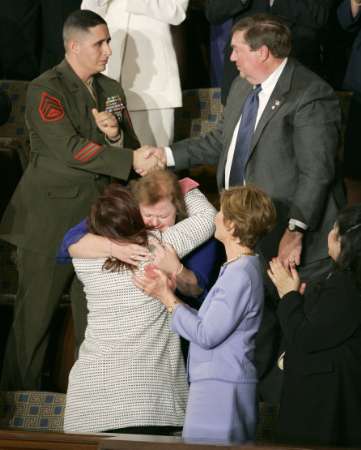
(picture from Lucianne.com via Lori Byrd's Byrd Droppings.)
I only caught part of the State of the Union address on the radio last night, as well as part of the Democratic response, so I don't have a lot of analysis on those as of yet. I suppose I should have TiVoed it.
However, I heard the commentators after Bush's speech explain the long period of applause after the President introduced the parents of Sgt. Byron Norwood, who had been killed assaulting Fallujah. The parents stood and the mother, Janet Norwood, was hugged by another guest, Safia Taleb al-Suhail, daughter of a man slain my Saddam Hussein's intelligence service. Earlier in the speech she had been identified and had raised his purple-stained index finger in a salute to the recent Iraqi election.
It was a visual confirmation of the appreciation the Iraqi people felt for the sacrifice of American troops. For me it was a visual picture until I found various postings this morning. Even over the radio, the commentator's description got to me. If anything undercut the weeks of Democratic sniping at the Iraqi election it was this moment.
If I dig them up from audible.com I'll comment further on these speeches.
Josh Poulson
Posted in category “Pictures, Politics” Thursday, Feb 3 2005 08:59 AM | Permalink | No comments | No trackbacks
Paul A. Volcker gives us a short report of the findings of the Independent Inquiry Committee into the United Nation's Oil for Food Program in today's Wall Street Journal:
We have found in each case that the procurement process was tainted, failing to follow the established rules of the organization designed to assure fairness and accountability. Perhaps not surprisingly, political considerations intruded, but in a manner that was neither transparent nor accountable.
The audit process, underfunded and undermanned, was unable to meet effectively the challenge posed by a really unique, massive and complex program of humanitarian assistance. Despite the skill and dedication of auditing professionals, the independence, the clear reporting lines and the management responsiveness critical to achieving a fully effective auditing process were lacking.
The management of Program administrative funds appears free of systematic or widespread abuse. But even there, a clear lapse from disciplined judgment has been found.
More disheartening are our findings with respect to the performance of the Executive Director in administrative charge of the Program, Benon Sevan, a long-term senior United Nations official. The evidence is conclusive that Mr. Sevan, in effectively participating in the selection of purchasers of oil under the Program, placed himself in an irreconcilable conflict of interest, in violation both of specific United Nations rules and of the broad responsibility of an international civil servant to adhere to the highest standards of trust and integrity.
One wonders how one can become a figure prominent enough to get considered for high-profile UN jobs without having substantial international interests, but the conflict of interest charge is interesting. What really is the problem here is widespread graft and corruption.
Mr. Volcker goes on to highlight the need for international organizations as evidenced by the recent tsunami disaster, but he tempers that with a warning that international organizations have to hold themselves to high standards.
A detailed report will come this summer. I'm sure we will all be curious about the billions of dollars that have disappeared, and the billions of dollars that turned into gold and luxuries for Saddam instead of food for his people.
Update: Report is here.
Josh Poulson
Posted in category “Politics” Thursday, Feb 3 2005 08:17 AM | Permalink | No comments | No trackbacks
Although the Ninth Circuit seems to get reversed a lot, they have another lethal force decision. This one appears to muck with the legal definition. In Smith v. City of Hemet they look at a police excessive use of force case, but they also get an opportunity to rewrite law:
We also take this occasion to bring our circuit into line with the others with respect to the definition of “deadly force.”
… We also hold that in this circuit “deadly force” has the same meaning as it does in the other circuits that have defined the term, a definition that finds its origin in the Model Penal Code. We define deadly force as force that creates a substantial risk of causing death or serious bodily injury.
Why is this important to the case? Because Smith's behavior was supposedly not enough to warrant excessive force…
By even the defendants’ account, the force used against Smith was severe. The Hemet Police Department’s use of force policy, General Order U-102, classifies the use of both pepper spray and a police service dog as “intermediate” force. Defendants acknowledge that they employed both types of force, and that “intermediate” force is the most severe force authorized short of deadly force.
More severe than “intermediate”? You decide:
Under the facts as we must assess them for purposes of this appeal, the officers slammed Smith against the wall, threw him to the ground, slid him off the porch while face down, pepper-sprayed him repeatedly, and either permitted or instructed Quando [the police service dog] to attack him on three occasions,6 at least one such attack occurring while the officers had him pinned to the ground. The canine assault resulted in Quando’s teeth puncturing the skin on various parts of Smith’s body.
This is some discussion that concludes that the police did not need to use lethal force, and the police pretty much agreed.
Unfortunately, the Supreme Court did not explicitly define what constitutes deadly force in Garner, and the definition that we have previously announced is incorrect. In Vera Cruz v. City of Escondido, 139 F.3d 659, 663 (9th Cir. 1998) (as amended), this court considered the meaning of the term. In that case, we held that deadly force means “force reasonably likely to kill.” Id. at 660. In doing so, we expressly refused to add “or result in serious bodily injury,” a phrase that appears in the definition employed by all other circuits that have defined the term. Id. at 661-62. Similarly, we deliberately chose “reasonably likely” rather than “creates a substantial risk,” the phrase employed by all other courts of appeals to have confronted the question. Id. at 662-63. The definition the other circuits have adopted and that we adopt today is identical in most respects to that set forth in the Model Penal Code. See Model Penal Code § 3.11(2) (1962).
This time I think the Ninth Circuit is heading in the right direction, Deadly force should include “serious bodily injury” as such injury creates a finite possibility of getting killed. This new definition more closely follows the basic definition I use when teaching on the subject of deadly force:
That force which a reasonable and prudent person would consider capable of causing death or grave bodily harm.
This comes the Mas Ayoob's Judicious Use of Lethal Force coursework, and my subsequent certification to teach that same material.
Josh Poulson
Posted in category “Politics” Wednesday, Feb 2 2005 06:02 PM | Permalink | No comments | No trackbacks
Ayn Rand would have been one hundred years old today. She is best known for her books Atlas Shrugged, The Fountainhead and Anthem, all of which were intended to teach us her philosophy of Objectivism.
I came across objectivism and Ayn Rand after I had already received a dose of libertarianism from the works of L. Neil Smith. I found Smith's works to be more fun and less stark. I did not like how sex in Ayn Rand novels seemed to be a game of dominance and repression. Smith appreciated sensuality and a fun roll in the hay. Also, I've found Smith's libertarians (or “propertarians”) to be a lot nicer to other people than the elitist snobs in Rand's utopia.
Rand did have a more rigorous philosophy, though. She carefully expresses certain parameters to objectivism:
| Metaphysics: | Objective Reality | “Nature, to be commanded, must be obeyed” | Epistemology: | Reason | “You can't eat your cake and have it, too.” |
| Ethics: | Self-interest | “Man is an end in himself.” |
| Politics: | Capitalism | “Give me liberty or give me death.” |
Libertarianism and objectivism are related, as Edward Hudgins points out in his tribute to her 100th birthday:
Rand developed an ethos of rational self-interest, but this “virtue of selfishness” was not an anti-social creed for predators. Instead, it led Rand to her great insight that there is no conflict of interest between honest, rational individuals. Since individuals are ends in themselves, no one in society should initiate the use of force or fraud against others. All relationships should be based on mutual consent. This became the credo of the modern libertarian movement, found today in think tanks, publications and public policy proposals.
So, I consider Ayn Rand to be influential on my life and certainly my philosophy during my early college years. However, I would have to say that there are other great works that are equally influential, like The Lord of the Rings, Unintended Consequences, The Nagasaki Vector and The Cathedral and the Bazaar.
Today, I still remember the key point: Facts are facts (“A is A”). Ayn Rand's insistence on there being an objective reality is certainly one leg of my philosophical table. While I agree with objectivism in general terms, it is the absolutist form that I object to. I can be nice to other people without ruining them, although being too nice can make them dependent.
For example, I blog not just for my own benefit, but for the benefit of my readers.
Farewell, Ayn, I'm glad you made an impression on several generations.
Amazon.com links:
Josh Poulson
Posted in category “Politics” Wednesday, Feb 2 2005 04:12 PM | Permalink | No comments | No trackbacks
In the Olympian we see an article in favor of the capitol gun ban, SB 5344. That's not surprising. What is surprising is this quote:
[Brendan] Williams [D-Olympia] responded: “This is by no means gun control as that term is commonly used. What I would refer to as 'place and time' restrictions are as applicable to gun rights as they are to First Amendment rights. The rationale for concealed weapons is self-protection. Yet self-protection cannot be a principled motive for carrying a gun in the Legislative Building, as lethal force can generally only be used in response to lethal force under our self-defense laws—and if only the State Patrol were armed, whose lethal force would one have to protect oneself against?”
He seems to think that the only threat model at the capitol is people shooting at you. I, for one, recognize that there are a lot of ways one can be threatened with death or grave bodily harm. Admittedly, they already ban knives and other objects from the capitol, although that seems pretty silly to me, too. (I need to take note of the fact that Olympia apparently has a three inch blade limit. Other jurisdictions are longer.)
His statement contains a fallacy. He asserts that by making it illegal to carry on the capitol (they already have metal detectors to enforce it) that the only one that might threaten you with a gun on the capitol is the State Patrol. However, as an example, that presumes that someone authenticating as a State Patrol officer is not a threat (can anyone see the security risk in that?). As another example, imagine someone (or several of them) shooting their way into the capitol and getting past the troopers to the unprotected legislators and observers inside.
Personal protection is just that. You cannot abdicate personal protection. You cannot assign it to some troopers who are there to maintain order for the entire capitol. They have a hard enough mission without having to worry about me. Add to this the precedents that police are not obligated to protect individuals but rather society and you can see the key problem. I do not want my personal safety to be someone else's responsibility.
Williams seems to believe that when he and I are faced with the same risks (because we're on the capitol) that I should not be responsible for my own life, because he feels I threaten his. He can make that choice for himself, but I don't like it when he makes that choice for me. He made a choice to run for office and be there.
What I think is happening is that Williams is afraid of his constiuents. He considers his personal safety to be more important than theirs. He thinks his job is more important than theirs. To me he has become a malignant narcissist. He should be ignored. Certainly this self-important blow-hard shouldn't be in office.
Josh Poulson
Posted in category “Guns” Tuesday, Feb 1 2005 05:04 PM | Permalink | No comments | No trackbacks
We've received more updates from GOAL (Gun Owners Action League) about legislative activity in Washington. There's a ton of data.
| Senate bills | ||||
| # | Blurb | Sponsor | Status | Position |
|---|---|---|---|---|
| SB 5041 | Sentencing range | McCaslin (R-4) | S. Jud. | Neutral |
| SB 5131 | Insanity finding/firearms | Carrell (R-28) | S. Jud. | Neutral |
| SB 5167 | Firearm suppressors | Hargrove (D-24) | S. Jud. | Support |
| SB 5342 | Safe storage of firearms | Kohl-Welles (D-36) | S. Jud. | Oppose |
| SB 5343 | Gun show loophole | Kohl-Welles (D-36) | S. Jud. | Oppose |
| SB 5344 | Capitol campus gun ban | Fairley (D-32) | S. Jud. | Concerns |
| SB 5383 | Juvenile hunting licenses | Oke (R-26) | S. NatRes. | Neutral |
| SB 5475 | Assault weapon ban | Kline (D-37) | S. Jud. | Oppose |
| SB 5545 | Deployed military CPL renewal | Roach (R-31) | S. Jud. | Support |
| SB 5593 | .50 BMG rifle ban | Kline (D-37) | S. Jud. | Oppose |
| SB 5635 | Restoration of rights | Schoesler (R-9) | S. Jud. | Support |
| SJM 8005 | Manufacturer protection | Benton (R-17) | S. Jud. | Support |
| House bills | ||||
| # | Blurb | Sponsor | Status | Position |
| HB 1133 | Public disclosure law | Nixon (R-45) | H. StatGov. | Neutral |
| HB 1213 | Juvenile hunting licenses | Clements (R-14) | H. NatRes | Neutral |
| HB 1473 | Safe storage of firearms | Moeller (D-49) | H. Jud. | Oppose |
| HB 1489 | Capitol campus gun ban | Williams (D-22) | H. Jud. | Oppose |
| HB 1490 | Park/rec area gun ban | Darneille (D-27) | H. Jud. | Oppose |
| HB 1627 | Assault weapon ban | Kagi (D-32) | H. Jud. | Oppose |
| HJM 4002 | Manufacturer protection | Curtis (R-18) | H. Jud. | Support |
Josh Poulson
Posted in category “Guns” Tuesday, Feb 1 2005 08:02 AM | Permalink | No comments | 3 trackbacks


 |
 |

![[Feed]](http://pun.org/oslo/feed_blue_32.png) |
RSS/Atom Feed from Feedburner |
Powered by Movable Type 5.2.13
1093 Entries, 603 Comments, 148 Trackbacks


This work is licensed under a Creative Commons Attribution-Noncommercial-Share Alike 3.0 License.

Please credit Joshua R. Poulson and the URL of the article or image used.
The postings on this site are my own and don't represent anyone or any company's positions, strategies or opinions.
Icons from the /oslo/ directory are copyrighted by Firewheel Design (IconBuffet) and are covered by their license agreement.